A year ago, Susan Miles bid farewell to her diabetes medication—five insulin injections a day, one at each meal and two at bedtime—and cut her dosage of cholesterol-lowering statins in half. And she was only partway down the road toward improving her health.
“I know all about excuses. I’ve used the best of them,” says Miles, the ambulatory nursing director at the Ontario Medical Center in Southern California. Miles, 60, who's been with Kaiser Permanente for 34 years, tapped into the company’s tools and support systems—and her own willpower—to change her life for good. Despite her bad back, herniated disc and an arthritic knee, she has lost 94 pounds, changed her relationship with food and grown closer to family and co-workers.
“That’s really me,” she says, pointing to a picture on her desk of a much heavier woman.
Fat summer, skinny summer
Miles, an RN, always had a weight problem: “I’d have a fat summer, then a skinny summer.” She earned her bachelor’s and master’s degrees in nursing and moved up the career ladder at Kaiser Permanente. 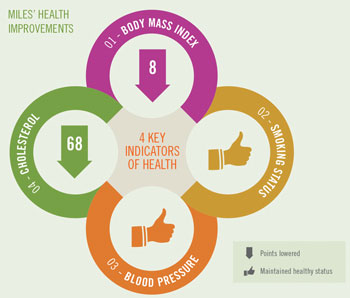 But the married mother of two children found it increasingly hard to take care of herself.
“I just didn’t feel good,” she says. “I loved my job, but it was getting harder to do. I had lost my mojo.”
More than two years ago, she tried taking the total health assessment (THA) but raced through it: Yes, her body mass index, or BMI, was almost 38, and of course, she had high cholesterol.
But when the statins got added to her medication regimen, she decided “it was my time to do something.” In February 2012, Miles enrolled in the weekly weight loss class offered at the Ontario facility. She retook the THA, slower, and “entered each and every line.”
“It puts a spotlight on all of your health issues,” says Miles, who used her THA statistics to help monitor her progress. In 16 weeks, she had shed 38 pounds. Her husband lost a few pounds, too, as he mirrored her eating. And the couple began taking weekday bike rides, breaking the cycle of “dinner, chores, bed”—with the bonus that they “rediscovered” each other.
Taking advantage of what’s available
Kaiser Permanente stands out in the field for focusing members on preventive health care and healthy eating, says Miles, who is quick to recommend KP programs—which helped her “reframe how I think about food”—to colleagues who marvel at her transformation.
“I haven’t stopped living, or eating,” she says. “We forget we are members too, not just employees. We need to take advantage of the programs we have. I really appreciate having KP physicians and dietitians at your fingertips to help you when you need it.”
From Miles’ perspective as a manager and an administrator, a healthy workforce is a happy and productive workforce.
“We depend on everyone being healthy and present,” she says. “We need to be models of that for our members.”
